Almost everyone who was born after the Ford Administration knows what "cheat codes" are. But for my fellow boomers I'll explain that cheat codes are (generally undocumented) special inputs to video games that allow the player to gain an advantage. They usually consist of pressing controller keys in a very exact sequence. They reward the game player with a variety of goodies: special powers and strength for their game avatar, or in "shooter" games, new and more powerful weapons or unlimited amunition.
You can search the internet for game walkthroughs and cheat codes. Whenever a new game comes out, dedicated players try out different obscure combinations of a game controllers keys, trying to find the combination that will give them an advantage in the game.
Game creators are aware of this interest and will make sure that cheat codes are "accidentally" leaked to their most loyal fans. These loyal fans then pass this along to their friends. There is even a market for books detailing the cheat codes of various video games.
My favorite nephew passed this tweet along to me this morning:
I was knocked back on my heels by this bit off tossed-off wisdom.
Proverbs do encode shortcuts to wisdom gathered through hard experience. Proverbs don't substitute for actually thinking the problem through.
Note the many proverbs that seem to contradict each other: "Many hands make light work," vs. "Too many cooks spoil the soup." or : "All things come to him who waits," vs. "Strike while the iron is hot."
But I do love the word image of the tweet, "I think proverbs may actually be cheat codes."
I love the idea that these nuggets of wisdom give us access to advantages put into our lives by the designer; and that if I take advantage of this wisdom I will find myself boosted with new strength, longer life, and unlimited spiritual amunition.
Heh.
Economically conservative social liberals are the “jackalopes of American politics.” - Jonah Goldberg
Tuesday, September 06, 2011
Saturday, January 29, 2011
Ischemic Attack!
The word is out on the digital street that I was in the E.R. last night, standing in for George Clooney. That's not entirely accurate.
Last Tuesday I felt a tingling sensation in my right leg, as though my leg were asleep. After a couple of hours the feeling passed. Thursday the sensation returned and covered the entire right side of my body. Friday night I checked my blood pressure and it was high. So Mrs. Islander drove me down to the Island Emergency Room.
Checking into the ER when you don't have a broken limb or gaping wound seems a bit false, as though you are malingering. At those prices, though, it's no joke. I could feel the money flying out of my wallet.
Because the issues involved are your own health and life, yet you spend so much time alone in a strange room, time spent in the ER swings from boring to fascinating. Lying in a bed, connected to different monitors, I couldn't get up and walk around, so I had to devise my own entertainment.
The monitors to which the nurses hooked me up are set to sound an alarm if the patient's bpm drop below 50. I have a normally low resting heart rate (49 beats per minute). After responding to the third alarm, the nurse reset the monitor alarm to 45 bpm.
I laid back, relaxed, and slowed my breathing, timing it to my heartbeats. I dropped my heart rate to 44 bpm and triggered the alarm again.
Good times, good times.
I was given a diagnosis of TIA Transient Ischemic Attack (mini-stroke). A CT scan could see no lesions (brain damage), so I'm doing well so far. (No snide remarks from my siblings--I have doctor's proof of no brain damage. Do you?)
Monday morning I report into my own doctor's office and get an ultrasound of my neck and schedule an MRI.
I'll post more as events warrant. You are free to go about your daily lives.
Tuesday, May 11, 2010
Friday, December 25, 2009
Outgeeked
This Christmastide we had as guests my wife's sister and her husband, Jim. As guys do, we sniffed around a couple of topics to see if we were from the same tribe.
He mentioned that he liked classic Sci-Fi, and I asked him to name a couple of favorite authors. (Think of that scene in The Commitments: "Who are your influences?"
Jim allowed that he used to be a big Piers Anthony fan. I asked him if he liked my favorite Anthony novel, Omnivore.
Without a word he rolled up his shirt sleeve to reveal a tattoo of the fungal carnivore.
I was completely outgeeked.
Tuesday, September 29, 2009
Thursday, September 24, 2009
Why I'm Rereading: Island in the Sea of Time
I have known several people in my life who never re-read a book. Once they have closed the cover on the last page, they are onto the next thing--book, task, whatever. I also know of people that have a favorite re-read. My friend Alex would re-read Dune every summer. It kind of defined summer to read it, I guess. My former boss Bill would re-read The Chronicles of Thomas Covenant, the Unbeliever every couple of years.
I am a person that rereads. I do so for several reasons. First of all, I reread for pure pleasure, re-experiencing the best of what I have read. Secondly, I re-read because books don't change, but I have changed since the last time I read a book. Thirdly, I re-read becuase The book was so challenging the first time that I want to get more from it on subsequent readings.
I am currently re-reading S.M. Stirling's alternate-history Island in the Sea of Time, which I first read back in the late 1990s.
Why?
I recently finished Sword of the Lady, the 6th book in his "Emberverse" series which is loosely connected to the "Island" series and I wanted to refresh my memory of the first events in the series before I arrive at the conclusion, "High King in Montival," next year.
My Sweety recently read the book at the urging of my Daughter and enjoyed it very much. (She's not much of an SF reader.)
And I have changed in the last 15 years. I have spent several years studying Japanese sword (Kenjutsu) and I am ranked Shodan-ni in Seiki-ryu Kentutsu/Jodo. So now reading the weapon-work of Captain Marion Alston is accompanied by better-informed mental images of what she is doing.
Monday, September 21, 2009
What would Milton Friedman do?
There are a lot of people exercised over the fear of government intervention into the US economy and I am one of them.
So why did I support (writing to my congresspeople) the TARP I bailout?
Thankfully, Kevin Williamson answers that question for me:
So why did I support (writing to my congresspeople) the TARP I bailout?
Thankfully, Kevin Williamson answers that question for me:
There are those conservatives who ask themselves, “What would Jesus do?” There are those who ask, “What would Ronald Reagan do?” There are even a few who ask, “What would Russell Kirk do, other than pour himself a scotch and shake his head sadly before writing another 1,000 pages?” I ask myself, “What would Milton Friedman do?”
Milton Friedman would have supported a bank bailout.
Or it seems he would have, given that a bank bailout is more or less what he prescribed for the last great financial crisis, the one leading up to the Great Depression, which he dwells upon at some length in his Monetary History of the United States, 1867–1960. The vulgarized version of Friedman: The Federal Reserve helped turn a routine if severe recession into the Great Depression by tightening the supply of money and credit. But as economists as different as Paul Krugman and Tyler Cowen have pointed out, the more accurate version is this: The Fed helped cause the Great Depression by allowing the supply of money and credit to tighten. The distinction is important. How did they allow it? By declining to bail out the failing banks...
Free-marketeers tend to think of our orientation not only as an economic position but also as a virtue. (It is.) But there is a danger in letting that belief congeal into dogma and, in consequence, allowing abstractions to obscure realities. It is true that the root evil here was government intervention in the economy: The Fed’s over-loose money after Dot-Bomb and 9/11, combined with tax incentives and the market-distorting actions of Fannie Mae and Freddie Mac, helped create the housing bubble; various government policies then helped turn that bubble into a global disaster. The subprime meltdown was not a failure of what is so often mischaracterized as “unbridled capitalism.” It was as much a failure of regulatory excess as of Scrooge McDuck, literally-rolling-in-it excess.
But it is not necessarily wise to start practicing austerities at the moment of crisis. Those who opposed the bailouts were, I think, seeking to restore the virtues of the free market — at precisely the wrong time. It is as though we had been diagnosed with lung cancer and responded merely by swearing off cigarettes. What about radiation therapy? What, are you crazy? Radiation gives you cancer! And people get sick in hospitals! ....
I suspect that many of us who opposed the bailouts did so based on unjustified optimism. Surely, we thought, the citizens of this commercial republic will have learned their lesson and will hasten to enact reforms that are consistent with their experience and liberal values. Those of us who believed that must somehow have missed the contemporaneous ascent of Barack Obama, whose election as president does not suggest that the nation is ready for a heaping helping of Adam Smith. Professor Cowen demands:
If you are a libertarian, is not our current course more favorable for liberty than would have been a repeat of 1929–1931? If not, I would be curious to hear your counterfactual version of how matters would have proceeded, without the financial bailouts. Is it that you think the regional banks would have raised the financing to pick up the entire bag and keep the banking system afloat? Or is it that natural market forces would have somehow avoided a wrenching surprise deflation? Or do you think the authorities for some reason would have not nationalized the major banks? . . . If we had not done the bailouts we did, we would, within a few months’ or weeks’ time, have received a much worse and costlier bailout run by Congress and Nancy Pelosi. How does that sound?
Sounds like hell on earth, professor.
Friday, June 05, 2009
The Religious urge for Multiverse
The Constant Reader may remember that I have problems with the current craze for resolving every ambiguity of physics with the concept of "multiverse."
And it is this final sentence that looses the arrow: "...anything beyond that is more a religious urge for transcendence than science."
Precisely!
Now, Lee Smolin, a founding member and research physicist at the Perimeter Institute for Theoretical Physics in Waterloo, Canada, has challenged other physicists to work out the implications of a single universe:
Smolin explains how theories describing a myriad of possible universes, with less or more dimensions and different kinds of particles and forces, have become increasingly popular in the last few years. However, through his work with the Brazilian philosopher Roberto Mangabeira Unger, Smolin believes that, despite there being good reasons for the conclusion that we live in a timeless multiverse, those theories, and the concomitant assumption that time is not a fundamental concept, are "profoundly mistaken".
Smolin points out why a timeless multiverse means that our laws of physics are no longer determinable from experiment and how the connection between fundamental laws, which are unique and applicable universally from first principles, and effective laws, which hold based on what we can actually observe, becomes unclear.
Smolin suggests a new set of principles that he hopes will begin a fresh adventure in science where we have to reconceive the notion of law to apply to a single universe that happens just once. These principles begin with the assertion that there is only one universe; that all that is real is real in a moment, as part of a succession of moments; and that everything that is real in a moment is a process of change leading to the next or future moments. As he explains, "If there is just one universe, there is no reason for a separation into laws and initial conditions, as we want a law to explain just one history of the one universe."
If we embrace the idea that there is only one universe and that time is a fundamental property of nature, then this opens up the possibility that the laws of physics evolve with time. As Smolin writes, "The notion of transcending our time-bound experiences in order to discover truths that hold timelessly is an unrealizable fantasy. When science succeeds, we do nothing of the sort; what we physicists really do is discover laws that hold in the universe we experience
within time. This, I would claim, should be enough; anything beyond that is more
a religious urge for transcendence than science."
And it is this final sentence that looses the arrow: "...anything beyond that is more a religious urge for transcendence than science."
Precisely!
Monday, May 18, 2009
"Shut up," He explained.
Lanny Davis: Hey, we'll only have show trials for people with the temerity to fight back!
He reminds me of the little boy caught fighting by his mother, "It all started when Timmy hit me back!"
Friday, May 15, 2009
Randism
The wonderfully named Scott Galupo writes that conservatives should get over their fascination with Ayn Rand's Atlas Shrugged.
Best line:
"Indeed, Miss Rand's writings are catnip for those who seek to deflect any and all blame for the current economic crisis away from the private sector. Like the airtight religious belief system that it essentially is, Randian capitalism can never stumble or fail — it can only be betrayed."Heh.
I first read The Fountainhead, then Atlas Shrugged when I was in my late 20s with a wife and two children to support. I found them an odd mix of stilted didactic text mixed with heaving-bosom "woman's fiction." I was entertained by how she walked her characters through their set pieces, but not swept up by thier wooden speechifying.
I guess you have to read Rand while in your teens to really be ruined by her books.
Thursday, May 14, 2009
A Rogue Agency
Just sent:
The Honorable Rick Larsen
Sir;
I am very troubled about the statements by the House Speaker, the Honorable Nancy Pelosi, about whether or not the CIA mislead her during briefings about enhanced interrogation techniques. The issue is much deeper and more dangerous than any particular interrogation techniques by agents of the CIA, it is a claim that the CIA has slipped from the reigns of congressional oversight, that we have that most frightening of spectres: a rogue secret intelligence agency.
These claims must be investigated to clear either the CIA or Speaker Pelosi. Secret agencies are a regrettable necessity, so we allow them to operate only under the oversight of our elected representatives. I ask you to call for an investigation of these claims, and to join with other representatives in calling for this investigation.
I will watch in the next few months to see that the American people and their freedoms and safety are guarded.
Saturday, May 09, 2009
Big Trek Theory
I can't remember which musician in Nirvana said it, but the quote went something like: "How do you know that you have made it in the music business? When Al Yankovic writes a parody of one of your songs."
So the meta-narrative validates the narrative.
The new Star Trek reboot seems to be taking off, but I wonder: how is it going to be handled on Big Bang Theory? Ripe grounds for nerd contraversy!
Friday, May 08, 2009
Five Reasons the GOP Will Rebound
Over at CNN, John Feehery lists five reasons that the GOP will rebound. Numbers one and two of these reasons have been pretty well discussed, but three through five are (to me) fresher:
- The party in power tends to overreach.
- People want checks on power.
- Crisis breeds renewal.
- Talent senses opportunity.
- The Republican Party is now the de facto Libertarian Party.
Tuesday, May 05, 2009
Gripes
Todd posted this:

see more Funny Graphs
This makes me rant a bit about remembering when the A&E channel stood for "Arts & Entertainment." I remember getting basic cable and really enjoying a presentation of The Mikado in which the Lord High Executioner's song had an encore wherein he listed all of the modern annoyances that would call for his sword's work (people that talked loudly on cell phones in public places, etc..).
Or when MTV was about music...or when Discovery was about science...or...
Back in the 1990s, one of the big arguments against funding of PBS was that these new cable channels would provide diversity of programming and fill the econiche of public TV.
How I wish it were true. The only channel that has kept true to that kind of charter is CSPAN.
A year after I was prodded by one of my sons-in-law, I signed up on Twitter.
O wonder!
How many goodly creatures are there here! How beauteous mankind is! O brave new world! That has such people in't!
O wonder!
How many goodly creatures are there here! How beauteous mankind is! O brave new world! That has such people in't!
Thursday, April 16, 2009
Science in Its Rightful Place
President Obama has stated in his inaugural address, "We will restore science to its rightful place." I guess that I am less that sure about where that place is.
What is science's place? If it has been displaced, what has usurped it?
I am sure to those (such as myself) who still hold a Modernist viewpoint, science is pretty much authoritative. And for questions that it was created to answer, science does pretty well. I am a big advocate of Western allopathic medicine, physics, information theory, and most of the rest of the Dead European White Man package. Given the choice between antibiotics and accupuncture and herbal cures, I say, "Pass the pills, please."
But physical science was created to answer one category of questions, not every category. One of the big lessons of the 20th century is that while science is good at answering questions of "how," (as in, "How do I build a bridge that spans the Golden Gate?"), it pretty much fails when asked the questions of "why," (as in, "Why should I not take everything away from people who are ethnically different from me?")
If science has been displaced, I think that it has been displaced by clearer thinking about "why" we should (or should not) attempt some actions. We should ask questions about the value of human life before we use science to design weapons of mass destruction. We should ask those same questions before we use science to justify subordinating human lives to those of animals.
During the High Middle Ages, theology was "The Queen of the Sciences," and served as the capstone to the Trivium and Quadrivium that young men were expected to study. This meant that the other subjects (including Philosophy) existed primarily to help with theological thought.
Science had better watch out. Nothing stays the same.
Friday, April 10, 2009
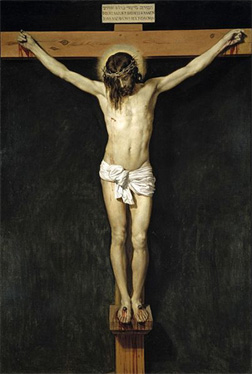
Good Friday Posting--Crucifixion
An admirable article at Slate about the significance of Jesus' crucifixion in the first century:
A central statement in traditional Christian creeds is that Jesus was crucified "under Pontius Pilate." But the majority of Christians have only the vaguest sense what the phrase represents, and most non-Christians probably can't imagine why it's such an integral part of Christian faith. "Crucified under Pontius Pilate" provides the Jesus story with its most obvious link to larger human history.
Pilate was a historical figure, the Roman procurator of Judea; he was referred to in other sources of the time and even mentioned in an inscription found at the site of ancient Caesarea in Israel. Linking Jesus' death with Pilate represents the insistence that Jesus was a real person, not merely a figure of myth or legend. More than this, the phrase also communicates concisely some pretty important specifics of that historical event...
...It's rather clear what St. Paul meant by saying that "the preaching of the cross is foolishness" to most people of his day. As Martin Hengel showed in Crucifixion in the Ancient World and the Folly of the Message of the Cross, Roman-era writers deemed crucifixion the worst imaginable fate, a punishment of unspeakable shamefulness. Celsus, a Roman critic of Christianity, ridiculed Christians for treating as divine someone who had been crucified. A second-century anti-Christian graffito from Rome, well-known among historians who study the time period, depicts a crudely drawn crucified man with a donkey's head; under it stands a human figure, and beneath this is a derisive scrawl: "Alexamenos worships his god."
A good reminder this Good Friday.
Saturday, March 21, 2009
Oh, the Humanity!
You walked to school in the snow? Well, not so much...
My 4 GB SanDisk MP3 player took a high-dive from my shirt pocket to swim in the toilet last week. So, I am back to my 256 MB Creative MuVo.
Kinda sad, but with the economy the way it is, I don't think I'll be upgrading for a while.
These are the stories that I'll tell my great-grandkids when they ask how hard things were in the Great Crash of 2009.
Friday, March 20, 2009
My Other Blog
Which phrase sounds slightly pretentious.
It's not that I have so many words bubbling up inside me that I need two blogs to capture them all. It's that I wanted a blog dedicated to the technical writing business that I can frankly use to promote myself.
So occasional politics- and social commentary-free postings can be found on: http://berylwrites.blogspot.com/
Subscribe to:
Posts (Atom)
Putting my Best Face Forward
So new day, new look. I am making another posting to what was never more that a shout-into-the-well blog. But I've updated the look of t...
-
Jim Baen has launched a new, electronic magazine, Jim Baen's Universe! While subscriptions start at $30, they range up to $500 in a mul...
-
I am compiling a style guide for my shiny new publications department (as a Wiki!). Part of that style guide is a list of "Best Practic...
-
So new day, new look. I am making another posting to what was never more that a shout-into-the-well blog. But I've updated the look of t...